
This year, I had the incredible honor of presenting for the first time at the Food & Nutrition Conference & Expo (FNCE) — the world’s largest gathering of dietitians and nutrition professionals.


Multidisciplinary Insights into Constipation for Adults
Our session, “Multidisciplinary Insights into Constipation: Dietitian and Physician Approaches for Adults,” filled the ballroom with hundreds of dietitians. Everyone’s eager to learn more about a topic that’s often overlooked, yet affects millions: constipation.

Why This Topic Matters
Constipation may not sound glamorous — but it’s one of the most common GI disorders we see in clinical practice. It affects quality of life, confidence, and even long-term health outcomes.
As dietitians, we hold a unique position to make a difference. Not just by recommending fiber and fluids, but by understanding the full picture of what drives bowel dysfunction.

What We Shared
Together with Dr. Carmen Fong, colorectal surgeon and author of Constipation Nation, and Yanjie Yu, RDN, CDCES, we explored the many faces of constipation and how dietitians can take a multidisciplinary, evidence-based approach to care.
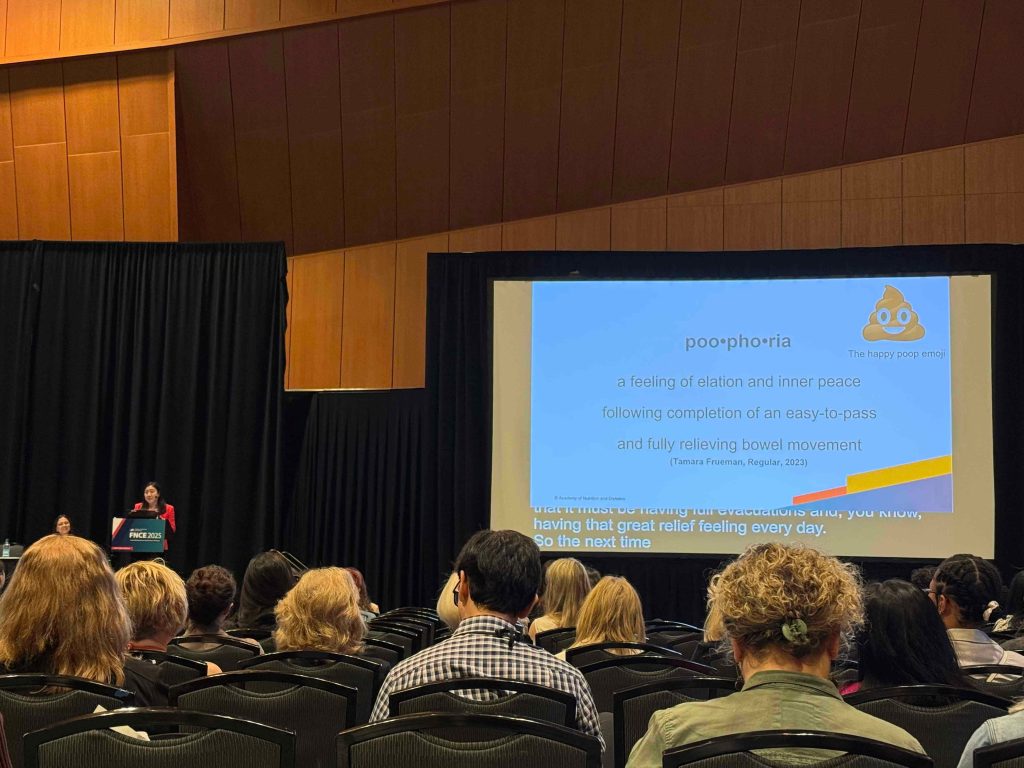
Here are a few highlights from our talk about constipation:
- Understanding the six types of constipation — from slow-transit to pelvic floor dysfunction.
- Implementing practical nutrition strategies focused on fiber variety, hydration, and meal timing.
- Recognizing the role of the gut–brain connection and collaborating with GI psychologists for gut-directed therapies.
- Integrating care with pelvic floor physical therapists and physicians to support motility and improve outcomes.
- Exploring constipation in pregnancy — as presented by Yanjie Yu, RDN, CDCES, who shared insights from her work in Maternal–Fetal Medicine (MFM) on preventing and resolving constipation during pregnancy through evidence-based nutrition and multidisciplinary care.
- Using tools like stool tracking and symptom pattern analysis to personalize treatment and monitor progress.
A Team Approach to Gut Health
Constipation care isn’t just about what patients eat — it’s about how they move, rest, manage stress, and feel supported.
As a dietitian, collaborating with GI specialists, psychologists, and pelvic floor PTs helps us see beyond fiber grams and hydration goals. It allows us to treat the whole person.
That’s the message we wanted to bring to the FNCE stage: that dietitians are central to effective, patient-centered GI care.


Gratitude and Community
FNCE is always about more than education — it’s about community. The hallway conversations, the shared laughter, and the moments that remind us why we chose this profession.
I also had the chance to volunteer with DMNT (Dietitians in Medical Nutrition Therapy) and DIGID (Dietitians in Gastrointestinal Disorders) this year. They’re two practice groups doing incredible work to elevate GI nutrition care and education.


Standing on that stage, looking out at a packed room of passionate dietitians, I was filled with gratitude — for my colleagues who push our field forward, and for the friends who encouraged me to take this leap.
Looking Ahead
Looking Ahead
The conversations we started at FNCE are just the beginning.
I’m passionate about continuing to equip dietitians with practical, evidence-based tools to better support patients with GI conditions like constipation.
Upcoming Education Opportunities:
- GLP-1 & GI Side Effects Webinar with Dr. Carmen Fong on Nov 5.
We’ll dive into how GLP-1 medications affect the gut, what dietitians need to know about managing side effects like constipation, and how to collaborate with GI providers for better outcomes.
Register here
Grab our handout: Managing GLP-1 Side Effect Cheatsheet - Epithelia Pro: Mastering Constipation Course
I’m thrilled to bring you an in-depth, practical course on constipation management in partnership with Epithelia Pro. This course helps dietitians confidently support patients from assessment through intervention.
Learn more here
Use code PRESALE for 25% off during the presale period.
Together, let’s keep advancing GI nutrition care — one collaboration, one conversation, and one bowel movement at a time.